Today we are
headed out to the farm!!! Clement’s father, Jean-Pierre, came home last night
from work in Lumbashi. To leave the city, we would have to drive past the
airport which I dreaded because I knew the traffic would be horrid. It wasn’t
too bad, but up until now I hadn’t experienced much air pollution. (Ok, there
is a lot of air pollution everywhere due to dust.) Here, it was terrible, not
from dust but from vehicle emissions which made breathing very tedious. Every
time people talk here, it sounds like the end of the world to me. It may only be
an off handed comment, but all I hear is “OH MY GOSH, WE ARE GOING TO DIE!”
clearly because I don’t understand the language or culture. Towards the airport
is a lot of “construction” (or what could possibly be though of as
construction) along the road, on the road, bridges, etc.
 |
| Smoking Fish |
 |
| Caterpillars |
Finally, we were out of the city
and stopped at a rural fish market to buy some supplies (that I would not be
eating). Children were selling cassava bread, caterpillars, fish, mbika
(pumpkin seed bread). I was able to take pictures here and they took pictures
with me. Another stop we make along the road was to see a big (bigger than two
ton) truck that Francios owns, but was broken down on the road. The driver had
been surviving here for a week on little to eat while waiting for a mechanic to
come along. I took the opportunity to photograph some landscape. The vast
tracks of land are owned by villages, but it was completely undeveloped and
covered in brush. They pointed out a large rural market as we drove past, there
is so much more space here and the people are somewhat quieter.
 |
| Fish Market |
 |
| On the Road to MAMPU |
As we continue to travel in some
directions that I am still uncertain of but generally East, the land looks more
and more like savannah, dry and covered in grass with a few trees dotting the
horizon. At first it was rather steep, (more than the Ozarks but not really
mountains) but soon it flattened out to a plateau of red sand and clay. On the
plateau, there is very little water so they must dig wells 60-90 meters deep
though it is only by trial and error to actually hit the water basin. We
crossed a river called Mai Ndobe (Black Water), which is strangely black considering
the dirt is yellow and red. Then we are back into mountains (or at least
steeper than before) and the roads are treacherous. Everything is surprisingly
well paved, but many curves hugging the mountains and large trucks barreling
down the other side. Many are without brakes, as you see a dozen people holding
on to the back of these enormous truck in an attempt to keep them from gaining too
much speed.
Jean-Pierre told me the roads
were built by the World Bank. They money was given directly to the suppliers,
so it wouldn’t slip through the fingers of the government. In return for the
“donation”, DRC is pressured to sell minerals to Europe to pay for membership
into the World Bank and make improvements to their overall economy. It is
maintained by a government agency that collects money from road tolls and oil
taxes.
As we near the farm, the grass
looks like kindling though the trees are still green. The dry season has only
begun. Francois’ first farm is located in MAMPU, the land here is mostly clay
with a layer of loose clay resembling sand on top. I can already imagine that
water retention here is a big problem. Most of the land on this side of the
highway is rented by USAid & World Vision who are conducting agriculture
experiments, namely GMO cassava. Yuck! Thankfully, the Congolese people do not
like the taste of GMO cassava or the idea of it. MAMPU is a German run
cooperative dedicated to promoting sustainable agroforestry, specifically to
produce charcoal for Kinshasa. The land is rented from the government by the
cooperative. This is a link to an informative video http://vimeo.com/8309679. The center of
Mampu is a village of the people who are running the operation of 8000 hectares
and a school for the laborers children. It is here that Francois made
arrangements for us to stay in the “guest house.” Then we drove the 7km out to
the first of her farms. Inside this cooperative, each farmer managed 25ha of
land. As we drive, Jean-Pierre notes that families live on each of the 25ha
plots and villages consist of four houses. The houses and water cellars are
constructed of cement by the cooperative. However, each plot has numerous dry
stick structures which house the laborers. In each of the villages, you can see
children running around in ragged clothing while parents are working and
carrying water.
 |
| Off the Highway |
 |
| Cooperation Houses |
 When we arrive at her farm, there is the usual 2 room cement building,
cylindrical water tank that collects water from the roof, 2 dry stick
buildings, and a long platform of sticks. This platform is used to dry cassava,
but I will talk about it later. I was anxious to see the acacia trees that grow
here along with cassava, so I chose a path and started walking only to have
everyone behind me laughing as apparently that was the way to the hole in the
ground (toilet). So after waiting for Francois to finish some business with the
family that lives on her property, meeting Papa Paul (the foreman), and taking
pictures of the village children, we were finally ready to see the operation. I
had initially believed the purpose of the farm was to grow cassava, but
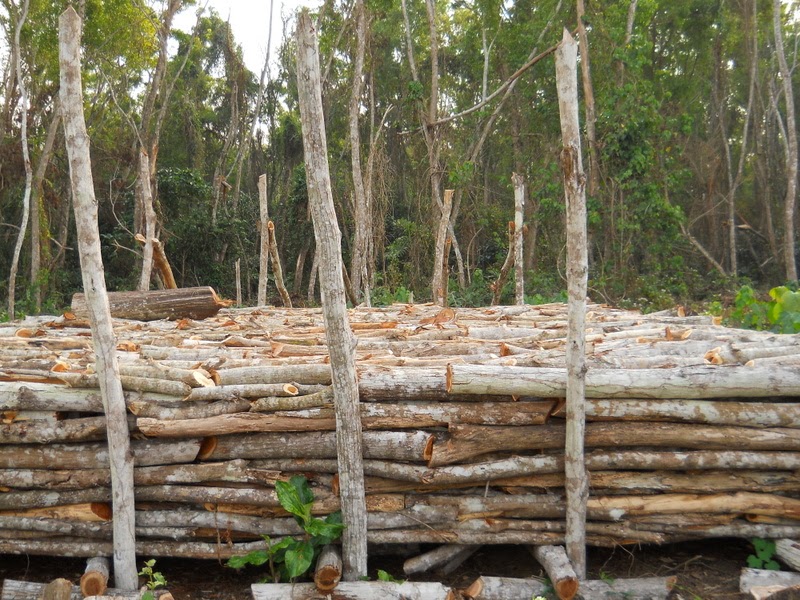
realistically that is secondary to charcoal production. The purpose of the
project was to appoint 25ha to families who needed work where they could grow
Acacia trees to alleviate the shortage of charcoal on the country, specifically
Kinshasa. Charcoal is what all families use to cook with since the electricity
is utterly unreliably. These trees were planted between 8 and 12 years ago and
each family is supposed to cut down 3ha per year to produce the charcoal. The
managers are supposed to replant the trees as they go and by the time they cut
all 25 ha, the replanted trees are ready to be harvested again. It seems to be
working well except some of the families do not replant. This
seems to be beneficial to society but not financially profitable according to
Jean-Pierre, I think it is a break even operation that provides work to
otherwise very poor families. On this farm, they wait a year in between cutting and
replanting to the Acacia to take advantage of the tree’s nitrogen-fixing characteristic
to grow an extremely productive year of cassava.
When we arrive at her farm, there is the usual 2 room cement building,
cylindrical water tank that collects water from the roof, 2 dry stick
buildings, and a long platform of sticks. This platform is used to dry cassava,
but I will talk about it later. I was anxious to see the acacia trees that grow
here along with cassava, so I chose a path and started walking only to have
everyone behind me laughing as apparently that was the way to the hole in the
ground (toilet). So after waiting for Francois to finish some business with the
family that lives on her property, meeting Papa Paul (the foreman), and taking
pictures of the village children, we were finally ready to see the operation. I
had initially believed the purpose of the farm was to grow cassava, but
realistically that is secondary to charcoal production. The purpose of the
project was to appoint 25ha to families who needed work where they could grow
Acacia trees to alleviate the shortage of charcoal on the country, specifically
Kinshasa. Charcoal is what all families use to cook with since the electricity
is utterly unreliably. These trees were planted between 8 and 12 years ago and
each family is supposed to cut down 3ha per year to produce the charcoal. The
managers are supposed to replant the trees as they go and by the time they cut
all 25 ha, the replanted trees are ready to be harvested again. It seems to be
working well except some of the families do not replant. This
seems to be beneficial to society but not financially profitable according to
Jean-Pierre, I think it is a break even operation that provides work to
otherwise very poor families. On this farm, they wait a year in between cutting and
replanting to the Acacia to take advantage of the tree’s nitrogen-fixing characteristic
to grow an extremely productive year of cassava.
The children from the village follow us as we examine the cassava and the
laborers explain the charcoal process. It is quick to write (quicker to read)
but all this information was gleaned over a period of many hours as it is
difficult to obtain. All this information had to go through one, maybe two
translators to get my point across or my question answered. For example, it didn’t
look like there was competition to the cassava plant and yet I still can’t
figure out how th
ey keep down the weeds. (After a couple more days spend there,
I got it figured out.) Papa Paul chopped at the cassava and pulled up some for
me to see. The children following us proceeded to carry it back to the village
and later I saw they had peeled off the outside and were eating it raw. Although
the cassava leaves can be eaten, they are generally consumed locally while the
roots are harvested and sent to the city. Cassava roots are dried and ground as
the main ingredient in Congolese bread, which is central to their cuisine. After
touring this farm, we are off to the next!
The second farm consisted of land originally belonging to the local
villages, but since they were not utilizing it at all apparently they found it
more productive to sell. Francoise owns 100ha and plants 5-10ha in cassava per
year. As there is no availability of fertilizer and the cassava does not follow
the acacia trees, she will wait ten years of growing and burning off the grass
before planting again in the same plot. The grass is burned every year as a
traditional way to fertilize the land in preparation for cultivation despite
how many years away that may be. On this property is her house, where she stays
when directly supervising the work on the farm. The houses consists of stakes
driven in to the ground and covered in tin. The cassava plants seemed to be
doing exceptionally well on the plot and Jean-Pierre congratulated her on the
hard work. What continues to amaze me is that despite all the fires, neither
the house, outdoor kitchen (or grass and sticks), nor the cassava drying racks
look touched by the flames!
 |
| Houses |
As we headed back down towards the village, we stopped at one of
Francoise’ friend’s house. Here I was able to observe the entire process of
cassava preparation. In this area, the massive problem is water. People have to walk miles to
a dirty river to obtain water for drinking, much less having it available to
wash dishes, laundry, rinse vegetables, or raise pigs and goats. This dry
season only lasts 4 months, but the tanks that drain rainwater are insufficient
to last. The second problem in labor, as all this farming takes vast amounts of
workers throughout the year. They cannot find enough people to bring in for
labor, nor do they have sufficient resources to sustain the people that do work
here. Tomorrow we are headed to her third farm.
 |
| Village Children |
I struggle with the issues here, because I cannot wrap my mind around
ways of improvement. Francoise believes that tractors will help solve the labor
shortage problem, yet I am afraid it will only leave more people without work.
Patrick believes that well could be a solution, however, each to build costs
upwards of $20,000 with no way to ever recoup those expenses. I cannot see a
clear path to improvement. These people are not educated, so they cannot leave
their work nor can they leave to become educated. Unemployment is rampant in
the cities, so at least here there is work.
The “guest house” we are staying in tonight is a cement building, which
is more than I expected considering it an indoor bathroom, running water,
mattress, and electricity. This adventure has left me with much to ponder and
will continue tomorrow. Having a Mars Bar along with my bread for dinner,
significantly improved my outlook on the world. Our electricity will be turned
off soon, so it’s off to bed for now.
 |
| Surveying the Fields |
 We awoke
this morning very refreshed and clean! We took breakfast in the resort before
heading out to see the falls. I stood outside to watch and hear the rapids
while everyone else finished eating. The water is very, murky brown and looks
massively powerful against the rocks. When everyone was (finally) finished, we
asked for a guide and began our trek to the falls. It is a steep path through
the jungle, but every moment worth it to see what awaited us. First, we came
across a tiny nonexistent pool, that only becomes a lake in the wet season. We
continued our hike upwards and then we could hear the falls, view them through
the trees, and begin to feel the mist. The trees fall away and suddenly we are
standing on a cliff directly in front of the falls while we are bathed in the
spray. It is a majestic and beautiful and awe-inspiring! Where we are standing,
the rocks are constantly coated with mist blown from the falls. I love standing
here with my arms outspread feeling the spray from the falls, like I’m on the
edge of the world. Francois, very worried about me, kept telling us all to
stand back from the edge, like any good mother! Clement, Jean-Pierre, Patrick,
and I continued on while Francois and Nancy stayed behind. There was a steep
rocky path down closer to the falls. I had been wearing sandals, but gave up at
this point and just went barefoot which was much easier. This path got us
completely soaked, but was well worth any inconvenience for the view. If you
yell into the falls, the echo causes the spray to become even stronger for just
a moment. This experience was awesome, I’m so happy we came here!
We awoke
this morning very refreshed and clean! We took breakfast in the resort before
heading out to see the falls. I stood outside to watch and hear the rapids
while everyone else finished eating. The water is very, murky brown and looks
massively powerful against the rocks. When everyone was (finally) finished, we
asked for a guide and began our trek to the falls. It is a steep path through
the jungle, but every moment worth it to see what awaited us. First, we came
across a tiny nonexistent pool, that only becomes a lake in the wet season. We
continued our hike upwards and then we could hear the falls, view them through
the trees, and begin to feel the mist. The trees fall away and suddenly we are
standing on a cliff directly in front of the falls while we are bathed in the
spray. It is a majestic and beautiful and awe-inspiring! Where we are standing,
the rocks are constantly coated with mist blown from the falls. I love standing
here with my arms outspread feeling the spray from the falls, like I’m on the
edge of the world. Francois, very worried about me, kept telling us all to
stand back from the edge, like any good mother! Clement, Jean-Pierre, Patrick,
and I continued on while Francois and Nancy stayed behind. There was a steep
rocky path down closer to the falls. I had been wearing sandals, but gave up at
this point and just went barefoot which was much easier. This path got us
completely soaked, but was well worth any inconvenience for the view. If you
yell into the falls, the echo causes the spray to become even stronger for just
a moment. This experience was awesome, I’m so happy we came here!